

Smart City
Smart city surveillance with Argu runs on premise at junctions, transit hubs and public squares, with biometric identification kept optional and subject to local law.
Smart city surveillance with Argu runs on premise at junctions, transit hubs and public squares, with biometric identification kept optional and subject to local law.
Explore real-world AI monitoring scenarios tailored to this industry.




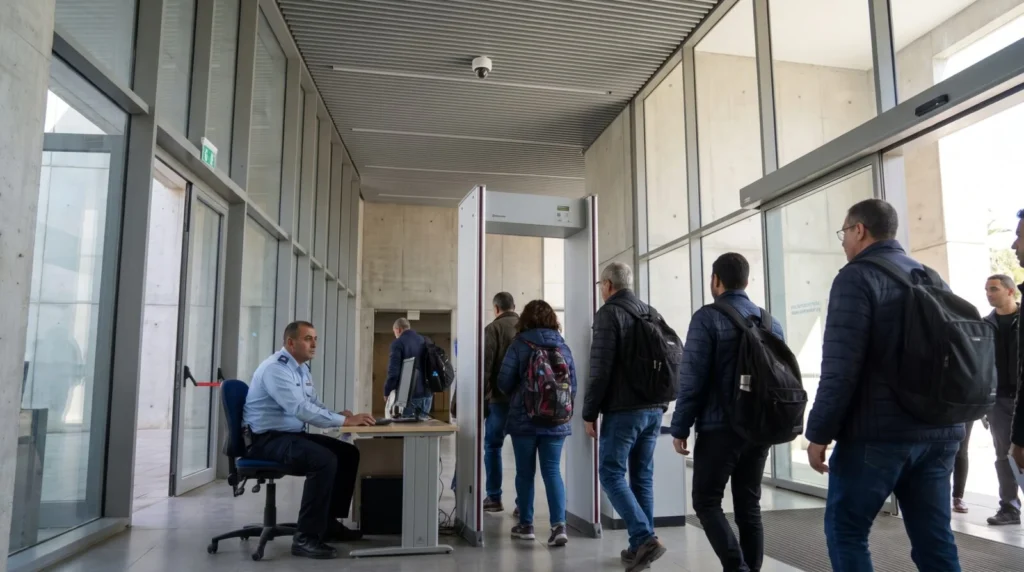


Smart city surveillance works only when a small operations team can act on a small fraction of a city's cameras, because most municipal systems already have far more cameras than anyone has time to watch live.
Most of what a municipal system needs is not live monitoring, it is finding the right moment in already recorded video once someone reports an incident. A mid sized city can run thousands of cameras across intersections, transit stations, parking structures and public buildings, watched by a control room staffed by a handful of people at any given hour, and nobody is looking at most of the feed most of the time.
A resident calls in a hit and run, a council member asks what happened at a specific corner last Tuesday, or a transit agency needs to confirm when a platform became overcrowded. Every one of those requests starts with a search through recorded video, and the search is usually the slow part of the job, not the recording itself.
How long that recorded video stays available is set by a retention schedule, not by the incident itself. Most municipal systems keep routine footage for 30 to 90 days before it is purged, so a report filed weeks late can already be outside the window an operator has to search.
Traffic is the most camera dense part of any city, and most of it is instrumented already: signal timing, automatic number plate recognition at key corridors, and dedicated cameras at high collision intersections. Reading a plate reliably at intersection speed and volume is a narrower job than general video review, which is why plate reading built for municipal scale is usually a separate capability layered onto the same camera network rather than a manual task.
Camera hardware alone does not make an automatic number plate recognition deployment reliable. Most guidance for reading plates at typical urban speed limits of 25 to 45 mph calls for at least a 1080p feed running at 15 to 30 frames per second, well above what a general purpose traffic camera captures by default.
A bus lane or a loading zone is only useful if it stays clear, and a human enforcement officer can only watch one block at a time. Camera coverage that already exists for traffic management can also confirm whether a vehicle stopped in a restricted lane, for how long, and whether it matches a pattern worth an officer's attention, without adding a second set of enforcement only cameras to the same corridor.
Extending parking and curb lane surveillance to a new block is usually a networking problem, not a construction project: a pole mounted camera on IEEE 802.3at (PoE+, up to 30 W) draws power over the same Ethernet run already feeding a traffic signal cabinet, within the standard 100 meter Cat6 limit before a switch or repeater is needed.
Public space safety in a city covers questions beyond traffic: crowd density building at a transit exit, an unattended bag left in a public square, illegal dumping at a known hotspot, and counting attendance at an outdoor event that never had a ticketed gate to count through. None of these need a new camera install, they are new questions asked of cameras a city already owns.
Answering those questions does not require new hardware. The same outdoor, typically IP66 rated cameras already covering a plaza or transit exit can support occupancy analytics for a crowd density question one week and a dumping hotspot question the next.
A single municipal camera estate is rarely used by one department alone. Police, transportation, parks and emergency services all have a reason to pull the same feed for different purposes, and that only works safely if permissions are specific to what each department is allowed to see and every access is logged. A transportation engineer reviewing congestion at an intersection does not need the same view as a police detective working an open case, and an audit trail that shows who looked at what, and when, is what lets a city defend that distinction if it is ever questioned.
Footage a police department pulls for an open case typically falls under CJIS Security Policy controls for criminal justice data, while a parks department pulling the same feed for a maintenance question does not. Access control scoped per department, backed by an ISO 27001 aligned policy, is how a single camera estate serves all four departments listed above without any one of them seeing more than it needs.
A private mall or a warehouse answers to its own management. A city answers to its residents, its council and often to public records law, and that changes what a responsible camera deployment looks like. Biometric identification such as facial matching should be treated as optional and subject to local law, not a default setting turned on because the hardware supports it. On premise deployment, clear retention rules and a real audit trail are not compliance overhead, they are what makes a public camera system defensible when a resident or a journalist asks a direct question about it, the same standard public infrastructure operators are held to more broadly.
In the United States, Section 889 of the 2019 NDAA restricts federal funding for certain video surveillance equipment on public sector networks, and a municipality drawing on federal grant dollars has to account for that when it selects camera hardware. A city operating under GDPR has a parallel obligation: Article 35 requires a Data Protection Impact Assessment before systematic, large scale monitoring of a public space goes live.
This is also where a fixed list of detection types becomes a liability rather than a convenience. A vendor that ships 40 pre built detectors is also shipping 40 categories of footage a city has decided, by default, to actively analyze, whether or not it has a policy reason to. Argu's approach is to let a city describe the specific, narrow situation it actually needs, such as a bag left unattended near a transit entrance, and begin watching for it in about 30 seconds, rather than running every camera through a fixed menu of detection classes it never asked for. Vision Agents built for a specific, described scenario can be scoped, logged and turned off as narrowly as the request that created them.
| Method | What it flags | When you learn about it |
|---|---|---|
| Manual live monitoring | Whatever an operator happens to be watching at that moment | Only if someone is on that feed when it happens |
| Fixed rule video analytics | A pre defined class, such as motion in a restricted zone | Close to real time, only for the class it was built for |
| ANPR at 1080p, 15 to 30 fps | A plate matching a watch list at speeds up to 45 mph | Near real time, on corridors already covered |
| Retention window footage review | Whatever was recorded inside the 30 to 90 day window | Manual search, after a report is filed |
| Plain language Vision Agents | Any situation described in a sentence, logged per department | About 30 seconds after it is described |
Talk to Argu about a municipal camera deployment if your city is weighing how to get more out of a camera network it already owns without expanding what it watches by default.
Last updated: September 2026
Smart city surveillance is the use of a municipality's existing camera network, at intersections, transit stations, parks and public buildings, to support traffic management, public safety and incident review. Most of the value comes from reviewing recorded footage after something is reported rather than watching every feed live. A city rarely adds cameras for this purpose, it gets more out of the ones it already has.
A control room is typically staffed by a small number of operators regardless of how many cameras the city runs, so only a small fraction of feeds can be watched live at any moment. The rest of the value comes from reviewing recorded video once an incident is reported. This gap is the main reason municipal camera systems are judged on search and review speed, not live coverage.
Automatic number plate recognition reads plates from camera footage at intersections and corridors, matching them against watch lists or logging them for later reference. At municipal scale it needs to work reliably across many vehicles, speeds and lighting conditions rather than a single controlled lane. It is typically layered onto traffic cameras a city already operates rather than requiring a separate camera network. Reliable reads at typical urban speed limits of 25 to 45 mph generally call for at least a 1080p feed running at 15 to 30 frames per second.
Police, transportation, parks and emergency services are the most common departments drawing on one municipal camera estate. Each department usually needs a different view and a different reason for access, which is why permissions are set per department rather than opened broadly. An audit trail showing who accessed which footage and when is what makes shared access defensible.
No, facial recognition and other biometric identification are optional capabilities, not a requirement of a municipal camera system. Whether to enable them depends on local law and city policy, and a responsible deployment treats that as a deliberate decision rather than a default. Most smart city use cases, such as traffic enforcement or crowd density monitoring, do not require identifying individuals at all. In the EU, GDPR Article 35 requires a Data Protection Impact Assessment before a public agency deploys systematic, large scale monitoring of a public space, biometric or not.
Most municipal systems keep routine footage for 30 to 90 days before it is purged, set by the public records retention schedule each jurisdiction publishes on its own. A report filed after that window closes can fall outside what is still available to search, which is why the retention period matters as much as camera coverage itself.
In the United States, Section 889 of the 2019 National Defense Authorization Act restricts federal funding for certain video surveillance equipment on public sector networks. A municipality that draws on federal grant dollars for a camera project has to account for that restriction when it selects hardware, separate from any state or local procurement rule.
The best fit works on the cameras a city already runs, because most municipal systems have far more cameras than operators to watch them. Look for natural language search of recorded footage, plate reading at junctions that holds up at urban speeds on 1080p feeds at 15 to 30 frames per second, and on-premise deployment. Argu AI adds these to an existing camera network, and a new Vision Agent can start watching a described scenario in about 30 seconds with no new dataset.


By submitting this form, you agree to our Privacy Policy. Your data is encrypted.