
Home » Argu Products » Fire & Smoke Detection
Fire & Smoke Detection
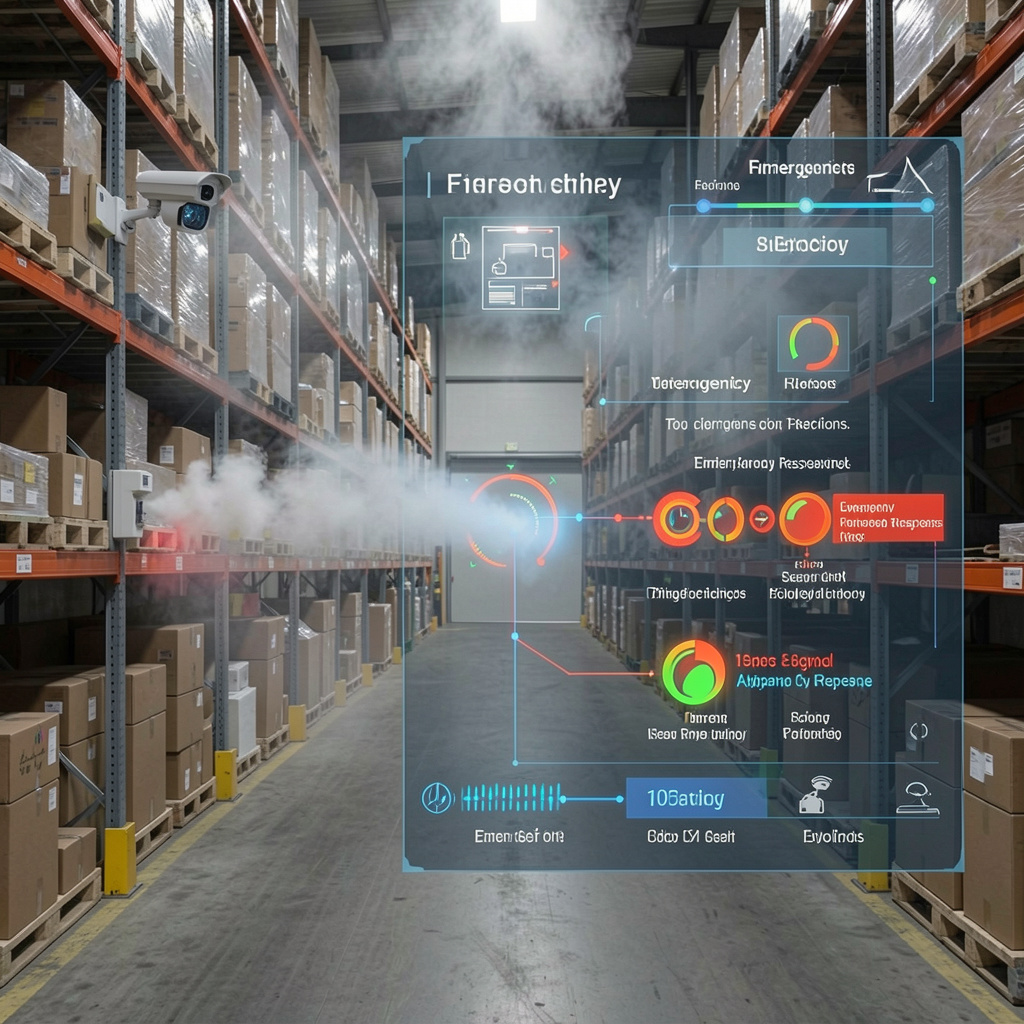
AI fire detection that spots a smoke plume anywhere in a warehouse or yard, not only in the small radius a ceiling sensor can reach.
The advantage is coverage plus a record. A camera watching an open yard or warehouse floor does not need to sit near where a fire starts, unlike a heat or particulate sensor mounted at fixed points on the ceiling. Once smoke is detected, a timer starts and runs until fire trucks enter the frame, producing response analytics a facility can use to tighten its emergency plan. Early smoke alerting across substations and yards belongs to critical infrastructure security planning.
- Response analytics record how long first responders took to arrive after detection: a timer starts the moment smoke or fire becomes visible and stops when fire trucks enter frame, the mechanism already described above.
- Camera-based monitoring is positioned as a complement to a facility's NFPA 72 fire alarm and detection system, not a replacement for a code-required point or aspirating detector.
- Coverage runs over standard RTSP or ONVIF Profile S/T/G camera feeds at 1080p–4K resolution, 15–30 fps, across the whole volume a camera can see rather than a single fixed sensor radius.
- Outdoor yard and warehouse-perimeter cameras are typically housed to an IP66 or IP67 rating under IEC 60529, suited to dust and weather exposure in a storage yard.
- A documented, time-stamped detection-to-arrival record is the kind of data NFPA 101 life-safety planning uses to review evacuation and response timing after an incident.
- No new sensor network is required; the agent runs on the cameras a facility already has watching its warehouse floors and yards.
Terminal operators fold early smoke alerting into a wider port security programme alongside the utilities coverage referenced above, and both fall under Argu's broader critical infrastructure security approach. Facilities that also want to understand how often a monitoring system fires unnecessarily can review Argu's notes on false alarm rate.
| Axis | Ceiling-mounted point / particulate sensor | Argu camera-based ai fire detection |
|---|---|---|
| What raises the alert | Smoke or heat physically reaching the sensor's fixed position | A visible smoke plume or flame detected anywhere in the camera's field of view |
| What a human must watch | An alarm-panel zone indicator only | A boxed detection on the live feed plus a running response timer |
| Integration path | New point or aspirating detector wiring per zone, spaced per NFPA 72 | Existing RTSP or ONVIF Profile S/T/G camera feeds already installed |
| Applicable standards context | Installed and spaced to meet NFPA 72 detector-placement requirements | Positioned as a complement to the facility's NFPA 72 system, adding coverage in the open volume between fixed detectors |
| Camera / feed required | None; a dedicated heat or particulate sensor | Standard 1080p–4K, 15–30 fps feeds, with outdoor units typically IP66/IP67-rated under IEC 60529 |
| What gets retained | An alarm-panel event log | A response timer plus the video record, from detection to fire trucks entering frame |