

HLS
Homeland security surveillance with Argu is in use across four continents with governments and critical infrastructure operators who need one continuous view and a person deciding the response.
Homeland security surveillance with Argu is in use across four continents with governments and critical infrastructure operators who need one continuous view and a person deciding the response.
Explore real-world AI monitoring scenarios tailored to this industry.


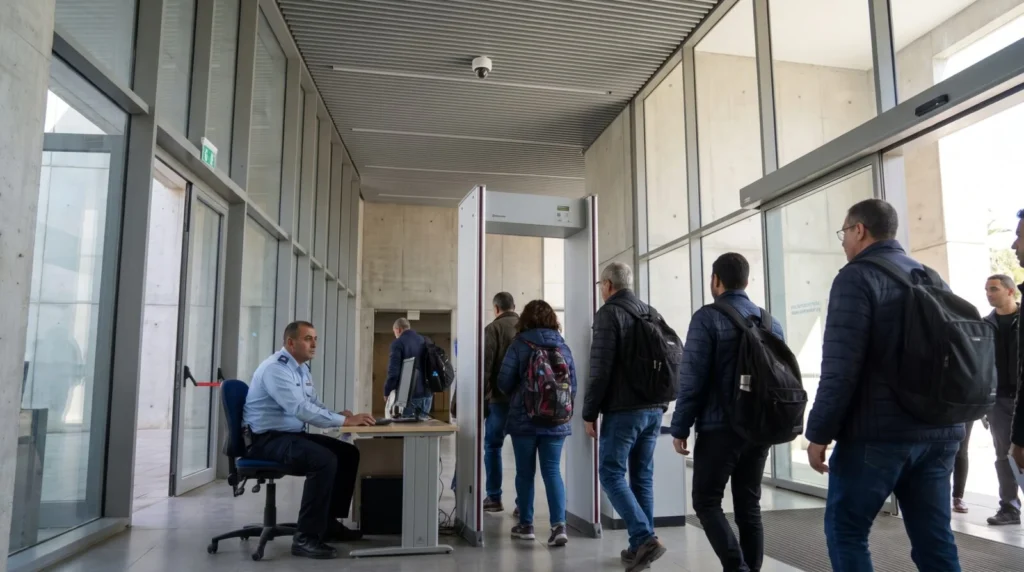


Homeland security surveillance is the layered use of cameras, access control, and behavioral monitoring at government and critical infrastructure sites to confirm who is on the property, what they are carrying, and whether their behavior matches the access they were granted. At a federal facility this coverage has to satisfy a security director, an operator on shift, and a procurement officer who has to justify the purchase in writing.
Most incidents at a secure entrance do not begin with an unknown person forcing a door. They begin with a badge and a face that do not match, or a second person following through a door that only opened for one. A controlled entry point depends on catching that mismatch in the seconds it happens, not on a log an investigator reads the next morning.
A badge reader confirms a credential. It does not confirm the person holding it. Federal credentials issued under FIPS 201, the government’s Personal Identity Verification standard, are designed to be paired with exactly this kind of face-at-the-reader check. Pairing entry logs with facial matching closes that gap: the system compares the face at the reader against the identity the badge claims, using 1:1 matching at a single door and 1:many matching when a name is not yet known.
Tailgating is a description, not a detection class a vendor can sell off a shelf, because every facility’s doors, lighting, and traffic patterns are different. A single tailgating event — one badge presented, two people passing through, no second scan — is exactly the one-to-two mismatch a badge log alone cannot catch. An operator who can describe the exact situation gets an agent built around that description instead of waiting for a vendor to add it to a future release.
A weapon detected at a public approach area only matters if it changes what happens next within seconds. Argu can trigger a lockdown protocol within three seconds of a weapon detection, which means the alert reaches whoever controls doors and access before the person reaches them.
Perimeter security is fundamentally about the time between first detection and the point a vehicle or person reaches something they should not. A longer standoff distance only helps if the system watching it responds in the seconds that distance buys. Perimeter design at many federal sites draws on premises-security guidance such as NFPA 730, which frames standoff distance as a function of response time, not fence height alone. Perimeter monitoring at a government site typically layers fence line coverage, vehicle screening at a checkpoint, and loitering detection along a restricted boundary, because a single camera type cannot cover all three well.
A vendor with forty pre-trained detection types has a ceiling at forty. A perimeter that borders a road, a loading dock, and open ground needs different judgment at each stretch, and a security director should not have to wait for a software update to cover the forty-first situation.
Federal buyers and the integrators who sell to them have to clear NDAA Section 889 before a camera system is evaluated on capability at all. Section 889 restricts the use of certain covered telecommunications and video surveillance equipment in federal contracts, so the sourcing question comes before the feature comparison, not after. Our own NDAA compliance guide walks through what counts as covered equipment under the FAR clauses that implement the law, one of the 16 critical infrastructure sectors and government-facility categories CISA coordinates security policy across, and the same procurement gate covered in our broader critical infrastructure security overview.
At a critical infrastructure or defense-adjacent site, sending video to a cloud vendor’s servers is not a matter of taste, it is frequently a condition the facility cannot waive. Cloud vendors typically point to a SOC 2 report to demonstrate data-handling controls, but SOC 2 attests to a vendor’s own environment, not to whether data ever leaves a facility’s network boundary at all — the distinction that matters for on-premise-only sites. On-premise deployment keeps footage, identity matches, and agent logic inside the facility’s own network boundary, under the facility’s own access controls, which is the structure most federal and defense procurement rules on data residency require.
A secure facility is staffed around the clock, but staffing does not solve the arithmetic: one operator cannot give forty screens the same attention in the first minute and the fortieth. Coverage has to include retrospective search, so an investigator can ask a plain question about what happened last week instead of scrubbing hours of footage by hand, and every alert and every acknowledgment has to log to a record that can stand up as evidence. Where footage has to be shared outside the facility, for a court filing or a public records request, video redaction lets an investigator release the relevant clip without exposing every bystander's face in the frame.
| Requirement | Fixed detector catalogue | Vision agent approach |
|---|---|---|
| New scenario at the site | Waits for a vendor release | Described in a sentence by the operator |
| Setup time for a new rule | Weeks to months, if offered at all | About 30 seconds |
| Training data needed | A labelled dataset per detector | None, the agent runs from the prompt |
| Who can create it | The vendor's engineering team | Security staff on site |
| Retrospective search | Limited to logged alert types | Plain language query across footage |
Argu was built for exactly this kind of site: a facility that cannot predict every situation in advance and cannot wait months for a vendor to add one. Instead of shipping a fixed menu of forty detectors, it lets the security team describe the exact situation they are worried about, a mismatch at a badge reader, a vehicle idling near a fence line, and turns that description into a working vision agent in about thirty seconds, with no dataset and no engineer required. The system is already deployed across four continents with governments, intelligence communities, and critical infrastructure operators who need that flexibility. Access control hardware already on site, including Argu's own access control integration, stays exactly where it is. For a facility evaluating its next security platform, the Argu team can walk through a specific site's requirements.
Last updated: September 2026
Homeland security surveillance is the layered use of cameras, access control, and behavioral monitoring at government and critical infrastructure sites to confirm identity at entry points, detect weapons and perimeter breaches, and produce an auditable record of what happened. These sites fall within the Government Facilities and related sectors among the 16 critical infrastructure sectors CISA coordinates security policy across. The goal is to give an operator both real time alerts and the ability to search past footage when an incident is reported later.
A badge reader only confirms that a valid credential, often issued under FIPS 201, the federal Personal Identity Verification standard, was presented, not that the person holding it is the person it belongs to, and it cannot tell whether a second person followed through the door behind them. Tailgating requires watching the door itself, not just the reader, and matching what the camera sees against who was authorized to enter. Facial matching at the point of entry, using 1:1 verification against the claimed badge identity, closes that specific gap.
NDAA Section 889 restricts the use of certain covered telecommunications and video surveillance equipment in federal contracts and by federal contractors. It affects which vendors and hardware a government buyer can even evaluate before a capability comparison begins. Any integrator selling into a federal or defense facility has to confirm compliance before the procurement conversation moves further.
Many federal, defense, and critical infrastructure sites are required or expected to keep video, identity matches, and system logic inside their own network boundary rather than sending it to an outside cloud provider. A SOC 2 report describes a cloud vendor's own environment, not whether data ever leaves the facility's network at all, which is why on-premise deployment is typically a requirement rather than a configuration choice at these sites.
No. A facility with dozens or hundreds of cameras and a small operations team cannot give every feed the same attention at every moment, which is why live watching alone is not a workable coverage strategy. Retrospective search lets an investigator find a specific person or event after the fact instead of relying on someone having watched the right screen at the right second. Automated alerts on specific, described situations fill the gap between the two.
Argu can trigger an automatic lockdown protocol within three seconds of a weapon detection at a public approach area, before the person reaches a controlled door. The alert carries a timestamped clip to the operator on shift and logs an audit entry recording when it fired and who acknowledged it, which matters for both the incident response and the after-action record.
Agencies typically combine facial matching at entry points, weapon detection, perimeter monitoring and searchable footage, and on federal contracts the hardware must first clear NDAA Section 889. Argu AI is already deployed with government, intelligence and critical-infrastructure operators across four continents, runs on premise on existing cameras, and a new vision agent can go live on an existing camera feed in about 30 seconds.


By submitting this form, you agree to our Privacy Policy. Your data is encrypted.